2026-9-10
LAMP in one lyophilized bead
no cold chain, read by eye
Four steps, thirty minutes, no fluorescence reader. The colorimetric LAMP kit now ships as a single lyophilized bead: reconstitute, amplify, read the colour.
A colorimetric LAMP result is a colour change you can see. That part was never the problem. The problem is everything the assay drags along with it: a cold chain from the factory to the bench, a fluorescence reader or a gel rig to confirm the call, and enough pipetting steps that a non-specialist has room to make a mistake.
Take any one of those away—and at a farm gate, a pond side, or a border inspection point, all three usually disappear at once—and the assay stops being practical, regardless of how well it performs in a controlled lab.
What changes with the bead
The new lyophilized colorimetric LAMP kit removes those dependencies rather than working around them. The reaction components are pre-mixed and freeze-dried into one pellet that sits in the reaction tube until you add liquid.
| Liquid LAMP workflow | EZassay lyophilized bead |
Cold chain | Required from factory to bench | Ships and holds at ambient temperature |
Readout | Fluorescence reader or gel rig required | Naked-eye colour change |
Setup | Multiple pipetting steps | Reconstitute and run |
Instrumentation | Reader plus heat source | Heat source only |
What is inside the bead
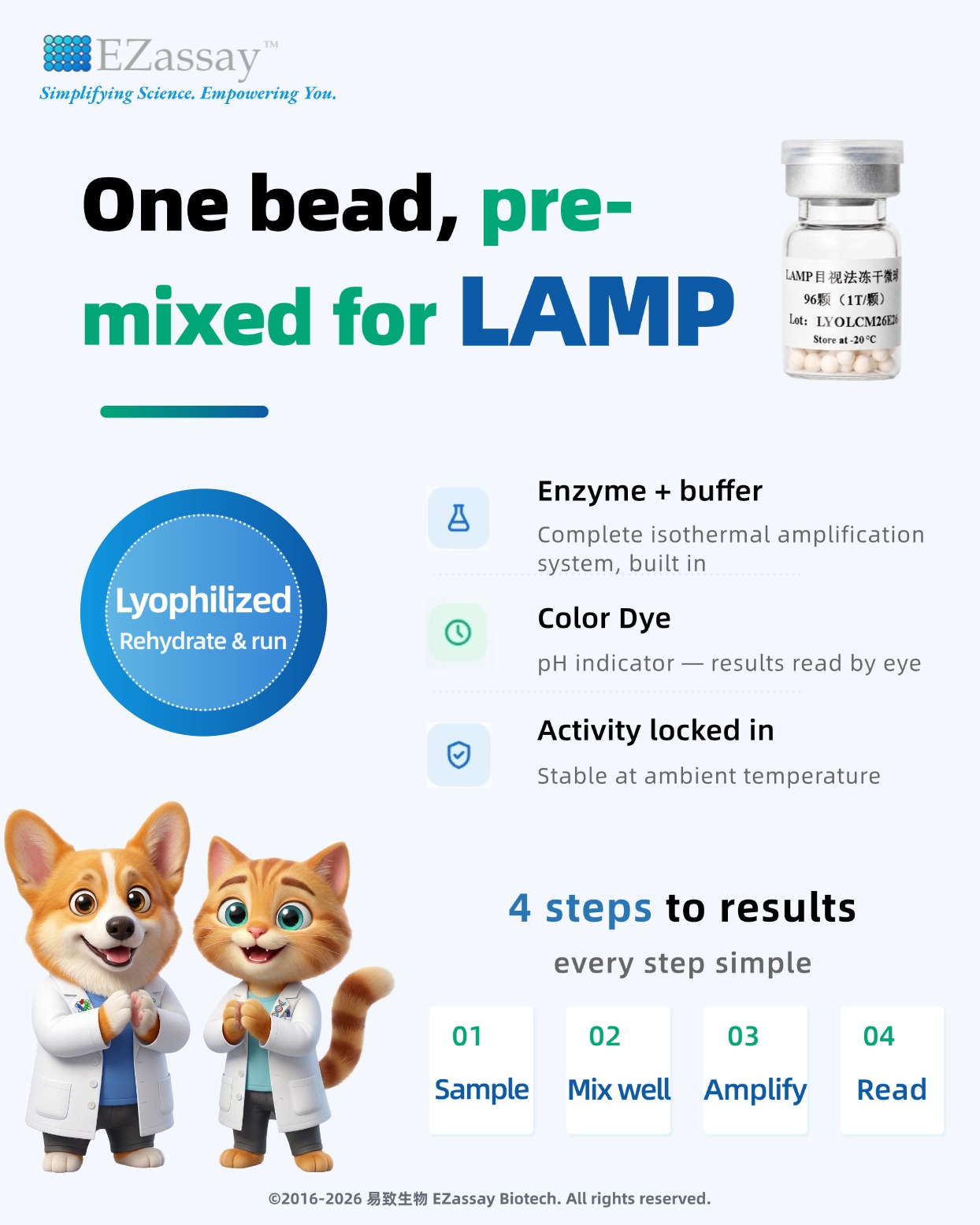
The bead carries the reaction: Bst 2.0 polymerase, reaction buffer, pH indicator and the other key reaction components, pre-mixed and freeze-dried into a single pellet. Target-specific primers, your own template (sample DNA or RNA) and nuclease-free water(or ddH2O) are added by the user.
A ready-to-use positive control and mineral oil come with the kit. Kits ship as 96T or 96T×10.
Four steps, 30 minutes
The protocol is deliberately short. Each step is one physical action—no transfer, no dilution, no precision pipetting.
1. Sample. Load your nucleic acid template into the reaction tube.
2. Mix well. Add the reaction mix to the bead and mix—the bead dissolves in seconds. No thawing, no separate reagent prep.
3. Amplify. Incubate isothermally at 60–65℃ for 30–40 minutes, then 85℃ for 5 minutes to stop the reaction. A dry bath or a heat block is sufficient.
4. Read. Cool to room temperature and read against a white background: pink (magenta) = negative, yellow (orange-yellow) = positive —the same principle as pH paper.
Where it goes
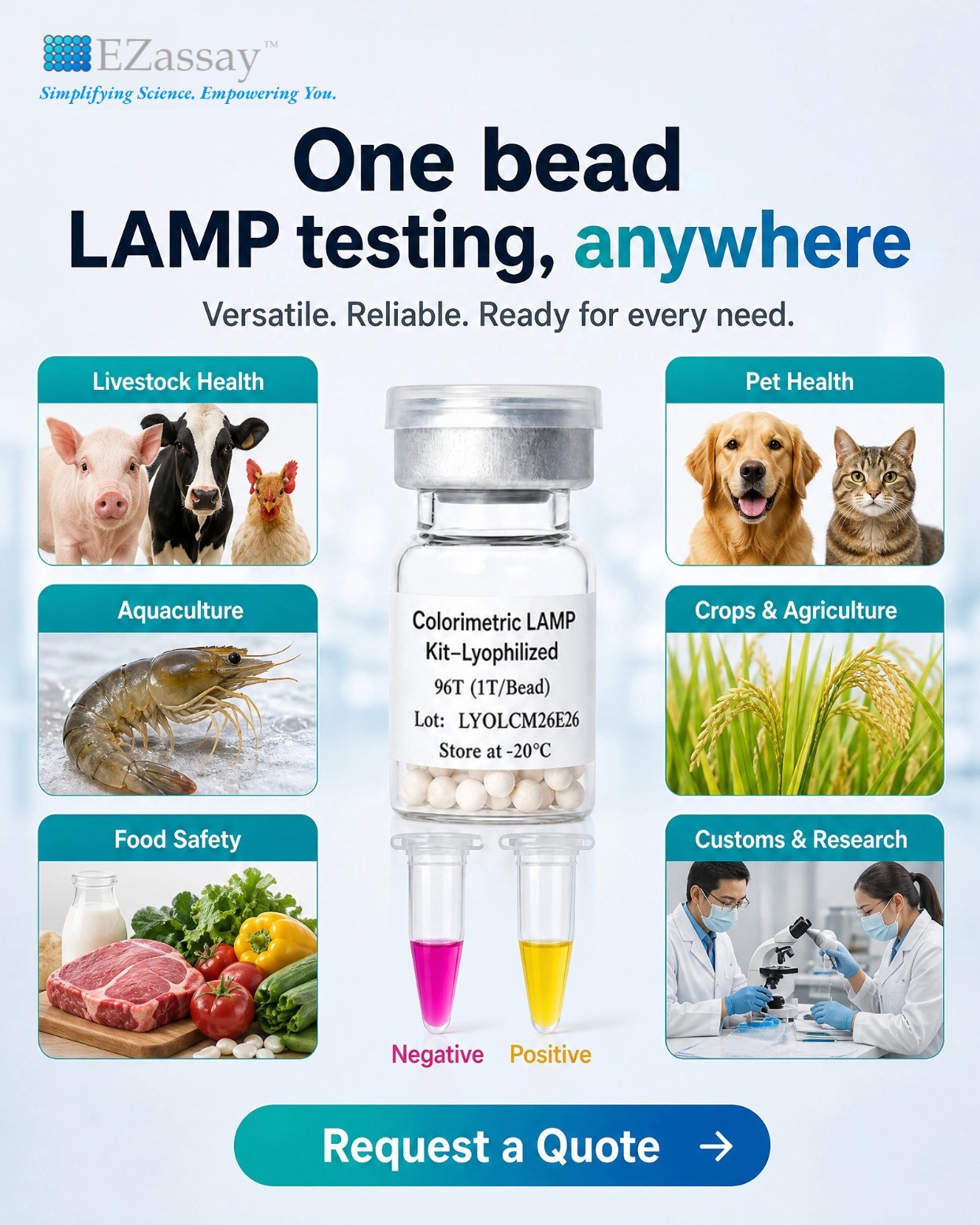
The bead format was designed for settings where a−80℃ freezer and a qPCR instrument are not realistic, and where the answer is needed the same day.
l Livestock health —ASFV, avian influenza (AIV) and other cattle, duck and sheep pathogen screening at the farm gate.
l Veterinary clinics —companion-animal respiratory and GI pathogens in a veterinary clinic-ready format.
l Aquaculture —WSSV, EHP and IHHNV testing at the pond side, no lab bench required.
l Crops and agriculture —rice SNP genotyping and crop pathogen screening for breeding and field programmes.
l Food safety —pathogen, adulteration and GMO screening along the supply chain.
l Customs and research —import and export inspection, applied R&D and academic studies.
Storage and handling
Keep the beads sealed and dry. Once a vial or strip is opened, reseal it with parafilm and place it in a sealed bag with desiccant. Ambient temperature is fine for up to 30 days; for long-term storage,−20℃ keeps the beads stable for up to 2 years.
Beyond the bead: the wider LAMP menu
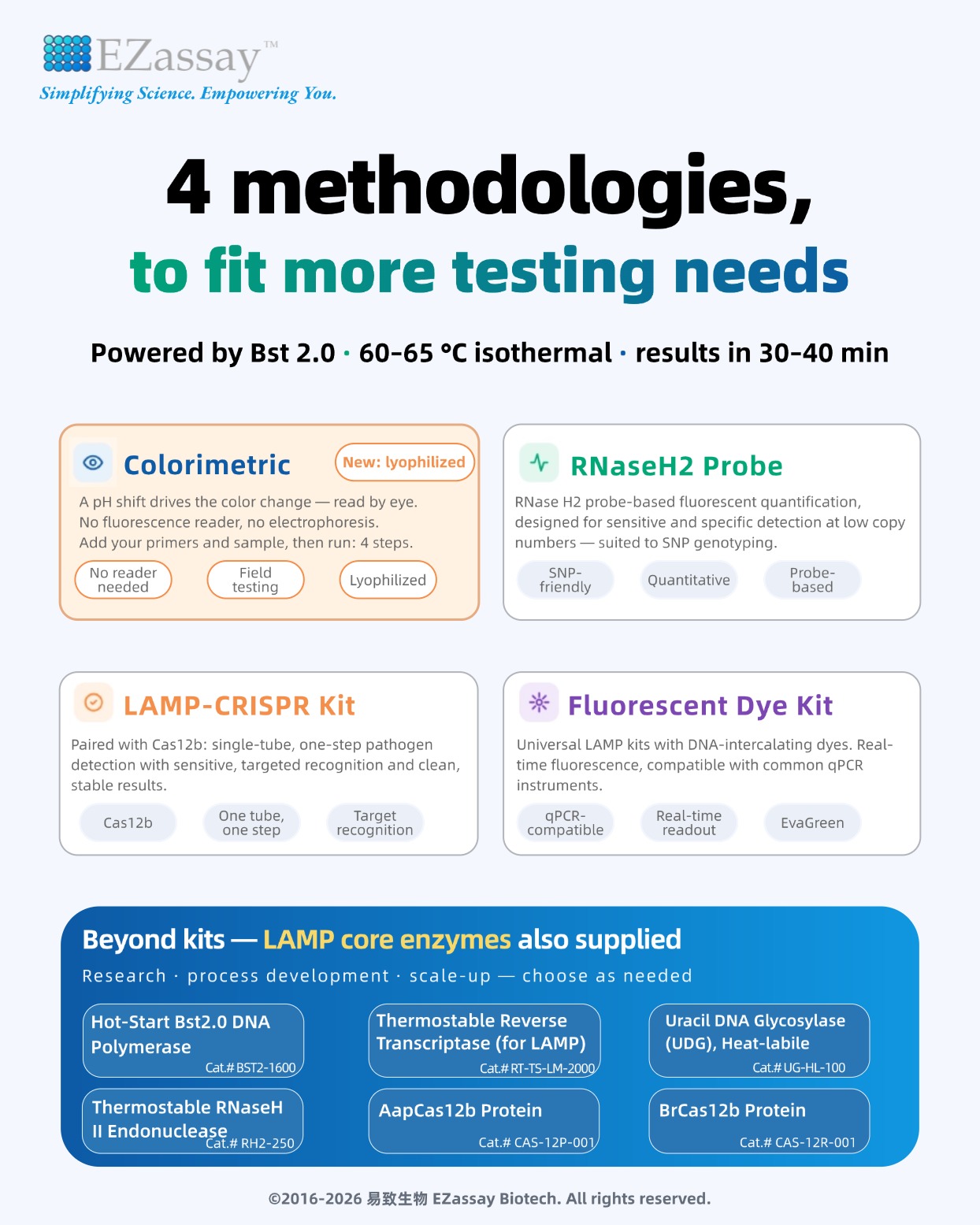
The lyophilized bead is one format inside a broader LAMP platform. If a project needs more than naked-eye readout, or is scaling past bead format, these sit alongside it:
l LAMP Fluorescent Kit—real-time fluorescent readout for higher throughput on qPCR-compatible instruments.
l RNase H2 Probe-Based LAMP Kit —l sequence-specific detection, suited to SNP genotyping.
l One-Step LAMP-CRISPR —paired with Cas12b for confirmation in the same tube.
l UDG anti-contamination option —available across the formats above to reduce the risk of carry-over contamination.
l LAMP related enzymes — Hot-Start Bst 2.0 polymerase, Thermostable RNaseH2, Cas12b and reverse transcriptase, supplied as standalone reagents.
Talk to us about your application
Tell us your target, your sample matrix and where the assay will be run, and we will point you to the bead, the kit or the format that suits it.