H01
Rapid. Results in as little as 10–20 minutes
RPA
A next-generation recombinase-based amplification technology for rapid, highly sensitive nucleic acid detection without thermal cycling.
H01
Rapid. Results in as little as 10–20 minutes
H02
Accurate. PCR-like sensitivity and specificity
H03
Stable. Lyophilized formats for convenient storage, transportation, and field use
Powered by proprietary enzyme technologies, our RPA platform is continuously optimized to deliver robust performance across both research and diagnostic applications. Selected workflows support extraction-free amplification, enabling faster testing and improved field deployment.
Available in basic, fluorescence, and lateral-flow formats to support diverse testing workflows.
Lyophilization-compatible formulations support ambient shipping and long-term storage for global deployment.
Minimal testing requirements, with support for portable readers or smartphone-based result capture.
Suitable for community clinics, township hospitals, field operations, and port-of-entry screening.
A side-by-side comparison of common amplification workflows, key characteristics, and application boundaries to help you quickly choose the right methodology for your scenario.
| Products | RPA | LAMP | RCA | PCR |
|---|---|---|---|---|
Temperature | 37~42°C | 60~65°C | 30~42°C or room temperature | 95°C-55°C-72°C cycling |
Specificity | ||||
Sensitivity | ||||
Equipment | Simple device | Simple device | Not required | Precision instrument |
Reaction Time | 15~30 minutes | 20~40 minutes | >4 hours | 90~120 minutes |
Cost | High | Low | Low | Low |
Applications |
|
|
|
|
Covers basic, lateral-flow, and fluorescence workflows, enabling quick switching by target type and readout mode.
Get personalized guidance from our technical experts to help solve complex research challenges, so you can stay focused on your science.
01
02
Call our team Mon–Fri from 8am to 5pm.
A collection of representative studies using this kit, highlighting its applications across diverse research areas.
Answers to common questions in product applications, helping you choose the right solution and troubleshoot experiments more efficiently.
● RPA and RAA are both recombinase-based isothermal amplification. ● RPA: Recombinase polymerase amplification. RAA: Recombinase aided amplification.
● To select the right one, you need to know your requirements and understand the features and differences of the RPA kits. - RPA Basic kit: mainly used to amplify DNA — meaning it makes millions to billions of copies of a specific DNA segment at isothermal temperature. You can observe the amplification product using agarose gel. - RPA Exo kit: It adds fluorescent probe (Exo probe) in the RPA basic kit to improve the specificity. You can read fluorescent value using Q-PCR. - RPA Nfo kit: It adds lateral flow probe (Nfo probe) in the RPA basic kit to improve the specificity. You can read the result using a test strip. ● Experience sharing: RPA Exo kit gives quantitative results. It is suitable for primer and probe optimization. With the most effective primer set and probe in Exo kit, you can easily get effective primer set and probe for Nfo kit.
EZassay website offers free online software for primer and probe design. (www.ezassay.com) ●First, paste the target DNA sequence in FASTA format into the dialog box. Due to server computational limitations, the target sequence should not be too long. Generally, 80-500 bp is sufficient. ●The web output shows different combinations of forward and reverse primers. Keeping the forward primer constant, multiple reverse primers can be selected, and vice versa. Each combination represents a different pairing. ●Download the Excel table and select 5-10 forward primers and 5-10 reverse primers from top to bottom for the first round of screening to identify the optimal combination. *Note: The best primers must be determined through experimental screening. The software currently cannot predict this accurately. Please be aware of this.
Covers RPA-related kits and supporting products, with category-based filtering for fast product targeting.
01
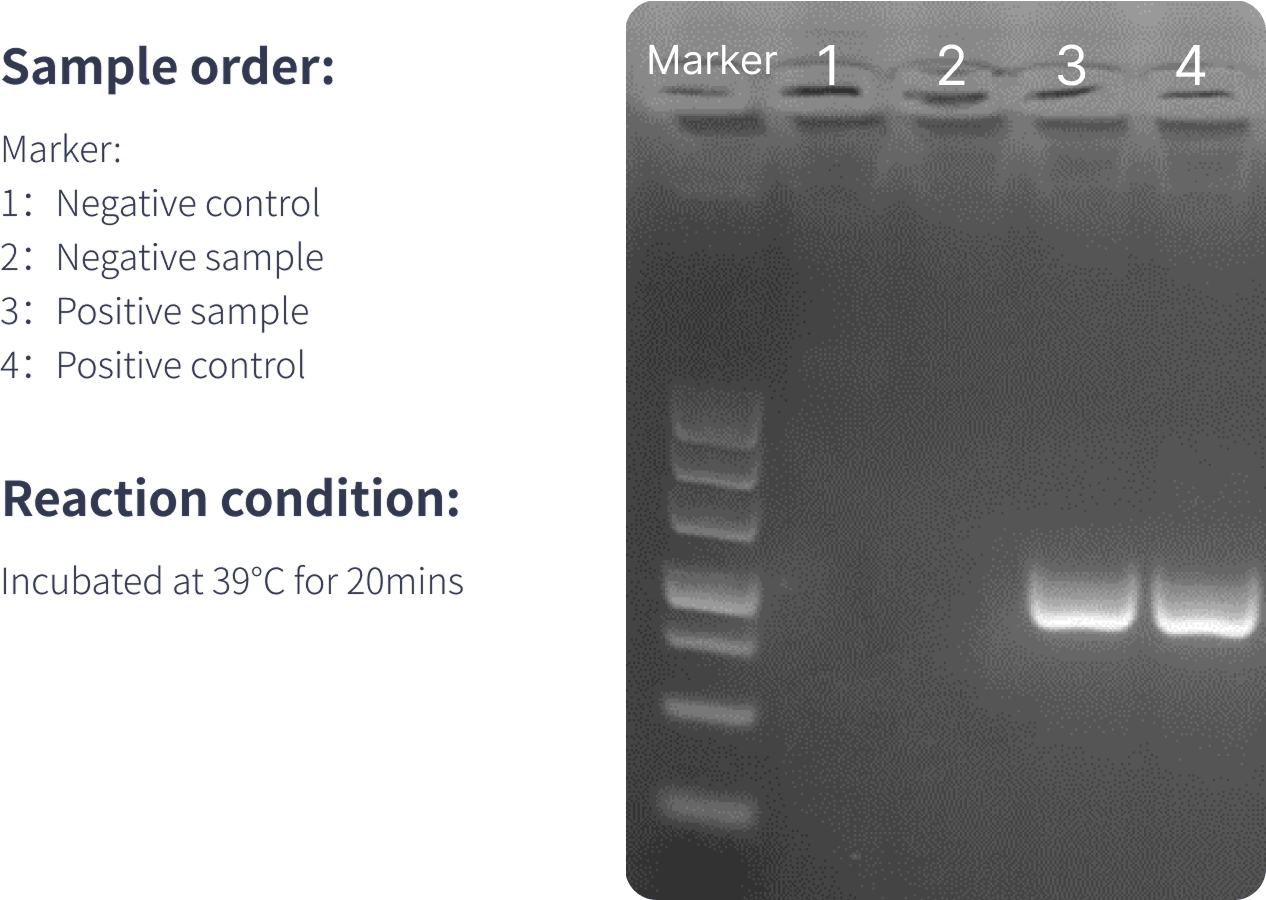
The basic kit completes DNA amplification only. Amplicons can be observed in agarose gel. This kit also works with CRISPR SHERLOCK and DETECTR.
02
Nfo probe is introduced into the reaction of the basic kit to improve the specificity. Test strip is used to read the result.
03
Exo probe is introduced into the reaction of the basic kit to improve the specificity. Fluoresent reader is used to read the result.
04
With RNA template, the RT basic kit synthesizes cDNA first and then complete the amplification of cDNA. Amplicons can be observed in agarose gel. This kit also works with CRISPR SHERLOCK and DETECTR.
05
Nfo probe is introduced into the reaction of the RT basic kit to improve the specificity. Test strip is used to read the result.