EZassay Lab Notes · LAMP Visual Readout
With colorimetric LAMP, the endpoint color is a key part of result interpretation. There is no amplification curve to review afterward. If the color is unclear or the result is misread, the test may need to be repeated.
Drawing on our lab experience, we’ve put together five practical tips covering the workflow from sample preparation to result interpretation.
01 Buffered Eluates May Interfere with Color Development
What you may see The incubation period is over, but the reaction remains pale violet, while other tubes in the same batch have changed color.
What to do If your sample was eluted in a buffered solution, consider re-eluting it in nuclease-free water or diluting it with nuclease-free water, as appropriate for your assay protocol. Buffer carried over with the sample may affect the indicator’s color change, even when only a small volume of sample is added.
02 Opening Amplified Tubes Near the Setup Area Can Cause Contamination
What you may see Negative controls begin turning orange after repeated runs, and changing to a fresh reagent lot does not resolve the issue.
What to do Keep the post-amplification area separate from the area used for reagent preparation and sample loading. Clean the workbench, pipettes, and centrifuge rotor according to your laboratory’s decontamination procedures. Carryover of amplified products is one possible cause of unexpected positive results, so check for contamination before assuming the reagents are at fault.
03 A Pale Violet Color After Reconstitution Is Not Necessarily a Problem
What you may see After reconstitution with water, the solution appears pale violet rather than magenta or orange-yellow.
What to do A pale violet color before the reaction is not, by itself, evidence of reagent deterioration. If the reagents have been stored and reconstituted as directed, proceed according to the assay protocol. For this colorimetric LAMP system, magenta indicates a negative result and orange-yellow indicates a positive result at the specified endpoint. Interpret the color at the recommended readout time rather than judging reagent performance by its appearance immediately after reconstitution.
04 Condensation and Evaporation Can Affect Color Interpretation
What you may see The liquid level appears lower than expected, droplets cling to the tube walls, or the reaction color looks more intense than in other tubes.
What to do If the reaction tubes remain sealed and your protocol permits it, briefly centrifuge them before reading to collect condensation at the bottom of the tubes and help ensure a more consistent visual readout. For batch testing in a water bath or heat block, use mineral oil only if specified in the product instructions. When applicable, the oil overlay can help reduce evaporation during incubation.
05 Read the Color at the Recommended Endpoint
What you may see The reaction appears magenta immediately after incubation, but orange develops around the edges after the tube has been left standing.
What to do Read the results promptly at the endpoint specified in the IFU and your project protocol. Avoid comparing tubes at different times after incubation, as delayed reading may affect color interpretation. For batch runs, follow a consistent reading sequence based on the time each reaction was started. This helps minimize differences caused by uneven delays between incubation and readout.
Where these details come from
The same deviations keep turning up in project reviews, in IFUs, and in customer questions — not as one-off mistakes. Change the target or the system and some of them reappear, which is why we collected them in one place.
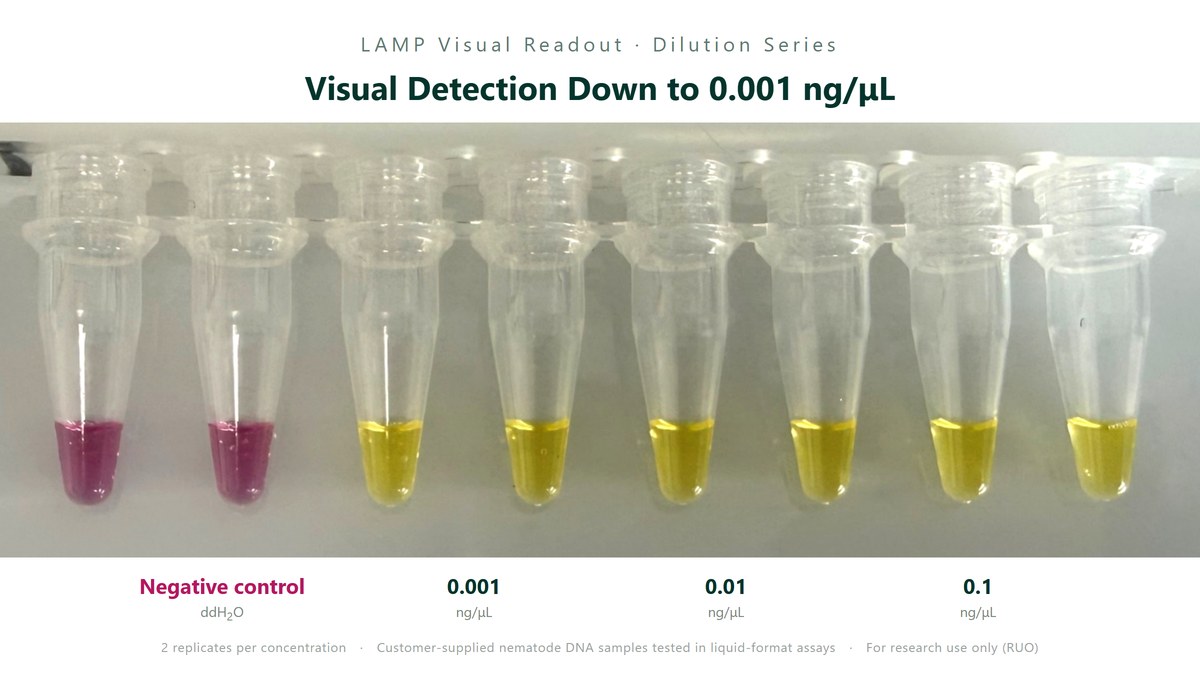
One project that went the whole way was a custom lyophilized LAMP assay for nematode DNA, read by eye. Readings from the dilution series in liquid format:
-
0.001ng/μL detected
-
0negative controls
no false positives
The path was liquid dilution series → pilot lyophilization → production batch. After reconstitution, reads matched the liquid controls, and the batch was released only after QC.
Lyophilization is not “freeze after aliquoting”
The formulation needs protectants, and the process has to be validated step by step as it scales. Lyophilization becomes a realistic option once the liquid format is shown to work — not before.
Have an assay you would like to move into lyophilized beads?
Scan to talk to our sales team
Or leave a note with your target and readout format
A final note
Colorimetric LAMP is straightforward to perform, but reliable interpretation depends on consistent sample preparation, contamination control, incubation conditions, and readout timing.
For assay-specific instructions, including incubation time, temperature, and result interpretation, always refer to the relevant EZassay IFU and your validated protocol.
#IsothermalAmplification #LAMP #MolecularDetection #LabTips #EZassay
For research use only (RUO); not for use in clinical diagnosis. The observations above come from lab records and customer support across several projects. They are meant to show where methodological variation commonly comes from, not to serve as a standard procedure for other systems or projects, and in several cases more than one explanation is consistent with what was seen. Reaction conditions, endpoint timing, and result interpretation follow the IFU supplied with the product and the applicable project protocol; timing windows vary between products and projects. No universal numbers are given here, and nothing in this article should be used as a basis for interpretation.