Cited in the Literature · CAS-12B-100
Advanced Science | 2026-07-23 | IF 14.1 | Open Access (CC BY 4.0), free full text | DOI 10.1002/advs.76576
The paper’s Methods section identifies EZassay Biotech as the supplier that expressed and purified the LbaCas12a used in the study (Cat. No. CAS-12B-100). The reported ~480-fold improvement, however, came from redesigning the activator, not from any change to the enzyme.
What the paper did. Cas12a is activated by a compatible DNA activator. In this study, the authors systematically varied nick positions in the two strands of a double-stranded DNA activator, testing individual positions and combinations to determine how each configuration affected Cas12a trans-cleavage activity. More than 200 configurations were evaluated. Both the intact and the split activators were tested against the same unmodified enzyme; the activator design was the experimental variable.
What they found. Nicks in the target strand (TS) generally reduced activity, whereas nicks in the non-target strand (NTS) enhanced activity in certain configurations. The effect therefore depended on where the nick sat and how the two strands were combined, not on strand identity alone. These findings were established in the authors’ experimental system; whether the same effects hold across other targets and assay designs requires separate validation.
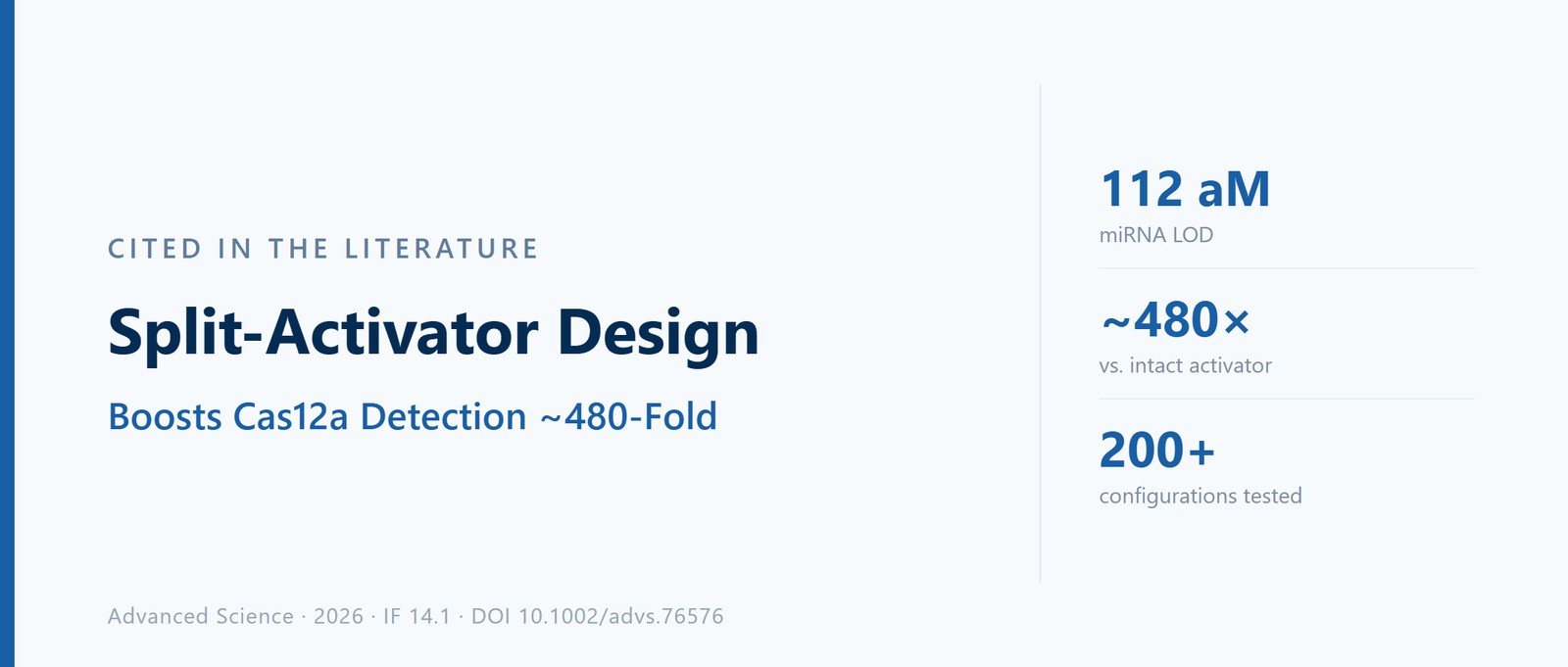
The key result. With selected split-activator configurations, the assay achieved a reported miRNA limit of detection (LOD) of 112 aM, approximately 480-fold lower than that of the intact-activator system used for comparison. The authors also applied the system to multiplexed analysis of five miRNAs in live cells and used the resulting profiles for cancer cell stratification. Taken together, the results show that activator design can substantially influence the analytical performance of a Cas12a-based detection system.
-
112 aMReported
miRNA LOD -
~480×Lower LOD vs.
intact activator -
200+Split-activator
configurations tested
From the paper’s Methods section
"The LbaCas12a (Cat No. CAS-12B-100) protein was expressed and purified by EZassay Biotech (Shenzhen, China)."
LbaCas12a · CAS-12B-100 (200 pmol)
LbaCas12a, also known as LbCpf1, is a Cas12a-family nuclease derived from Lachnospiraceae bacterium. It is a general reagent for CRISPR assay development, including workflows that combine isothermal amplification with Cas12a-based detection. Applications such as SNP discrimination and low-abundance miRNA detection require assay-specific optimization and validation. An enhanced version is also available in the same product series; the appropriate choice depends on the target, assay design, and readout requirements.
Lab note · practice, not a finding of this paper
When comparing activator designs, start with a positive control at a defined concentration and keep other reaction conditions consistent. Establishing a baseline helps control for run-to-run variation and makes differences between configurations easier to interpret. A change in signal alone does not identify its cause; further controls may be needed to separate the effect of activator design from other sources of variation.
Citation · copy-ready for reference managers
Tang X, Li Z, Lu Y, Ma M, Mo Z, Ke J, Luan X, Luan T, Zhai J. Systematic Position Mapping of Split CRISPR-Cas12a Activators Enables Highly Sensitive miRNA Detection and Cancer Cell Stratification. Adv Sci (Weinh). 2026 Oct;13(57):e76576. doi: 10.1002/advs.76576. PMID: 42489285; PMCID: PMC13393258.
Free full text: pmc.ncbi.nlm.nih.gov/articles/PMC13393258 | DOI: doi.org/10.1002/advs.76576
Want the original paper, or a view on whether CAS-12B fits your system?
Scan to talk to our sales team
Or leave a message with your target and assay format
#CRISPR #Cas12a #MolecularDetection #LabTips #EZassay
Impact factor per the 2025 JCR. The summary above paraphrases the original publication, which prevails over any wording here; nothing on this page is a performance claim for the product. For research use only (RUO); not for use in clinical diagnosis.