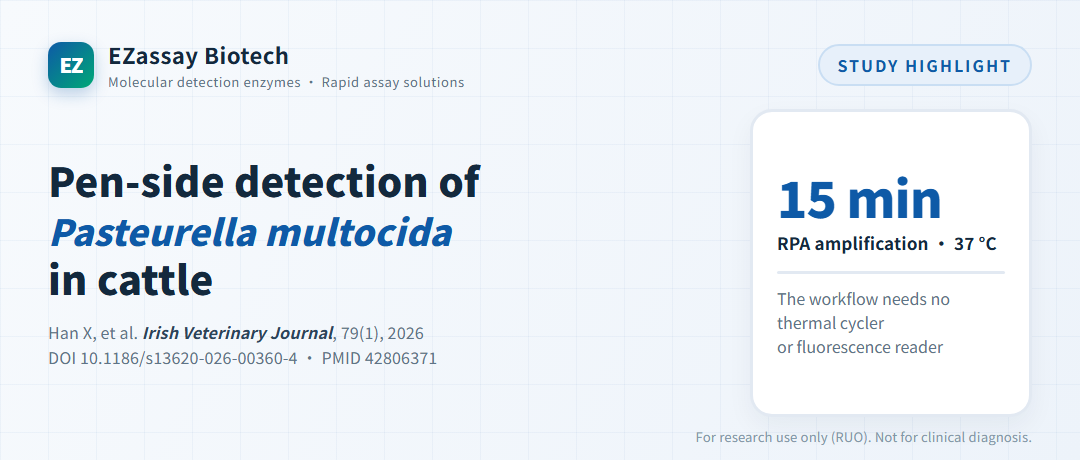
The RPA kit used in this workflow appears in a study published in Irish Veterinary Journal.
Bovine respiratory disease (BRD) remains a major challenge in cattle production. Identifying bacterial pathogens such as Pasteurella multocida often depends on laboratory-based methods, which can limit access to timely results in resource-limited settings.
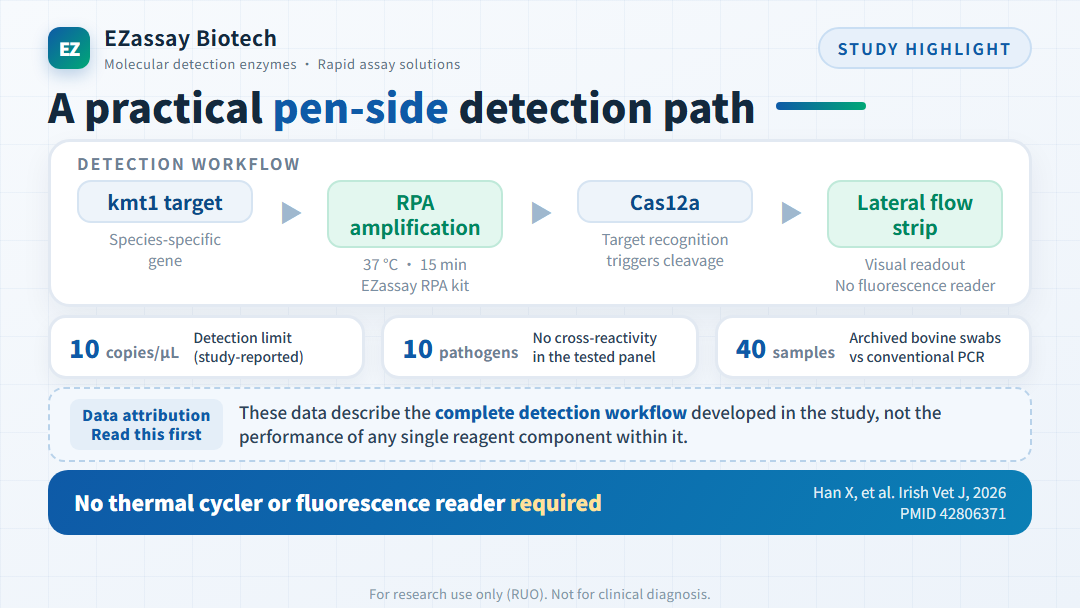
A recent study by researchers at the College of Veterinary Medicine, Qingdao Agricultural University, demonstrates the potential of an RPA-CRISPR/Cas12a workflow for on-site pathogen detection. Targeting kmt1, a species-specific gene of P. multocida, the researchers developed an assay combining recombinase polymerase amplification (RPA), CRISPR/Cas12a detection, and lateral flow strip (LFS) readout.
RPA amplification was completed in 15 minutes at 37 °C. Following CRISPR/Cas12a detection, results could be visually interpreted using a lateral flow strip, without requiring a thermal cycler or fluorescence reader.
Study Highlights
The study reported a detection limit of 10 copies/µL, with no cross-reactivity against ten other tested bovine pathogens, including Mannheimia haemolytica, Histophilus somni, and bovine viral diarrhea virus.
In a blinded validation against conventional PCR, the assay showed complete agreement across 40 archived bovine nasal swab samples collected from cattle with clinical signs of BRD at commercial farms (17 positive, 23 negative).
In a separate validation involving 42 clinical nasal swab samples, the assay also showed 100% agreement with real-time qPCR, with reference Ct values ranging from 16.0 to 35.0 (36 positive, 6 negative).
These data describe the complete detection workflow developed in the study, not the performance of any single reagent component within it.
Where EZassay's RPA Kit Fits in This Workflow
Integrated Product Portfolio
EZassay offers RPA amplification reagents and lateral flow strips as part of its broader molecular detection product portfolio, giving customers the convenience of sourcing both amplification and visual readout products from one supplier.
Integrated UDG Contamination Control
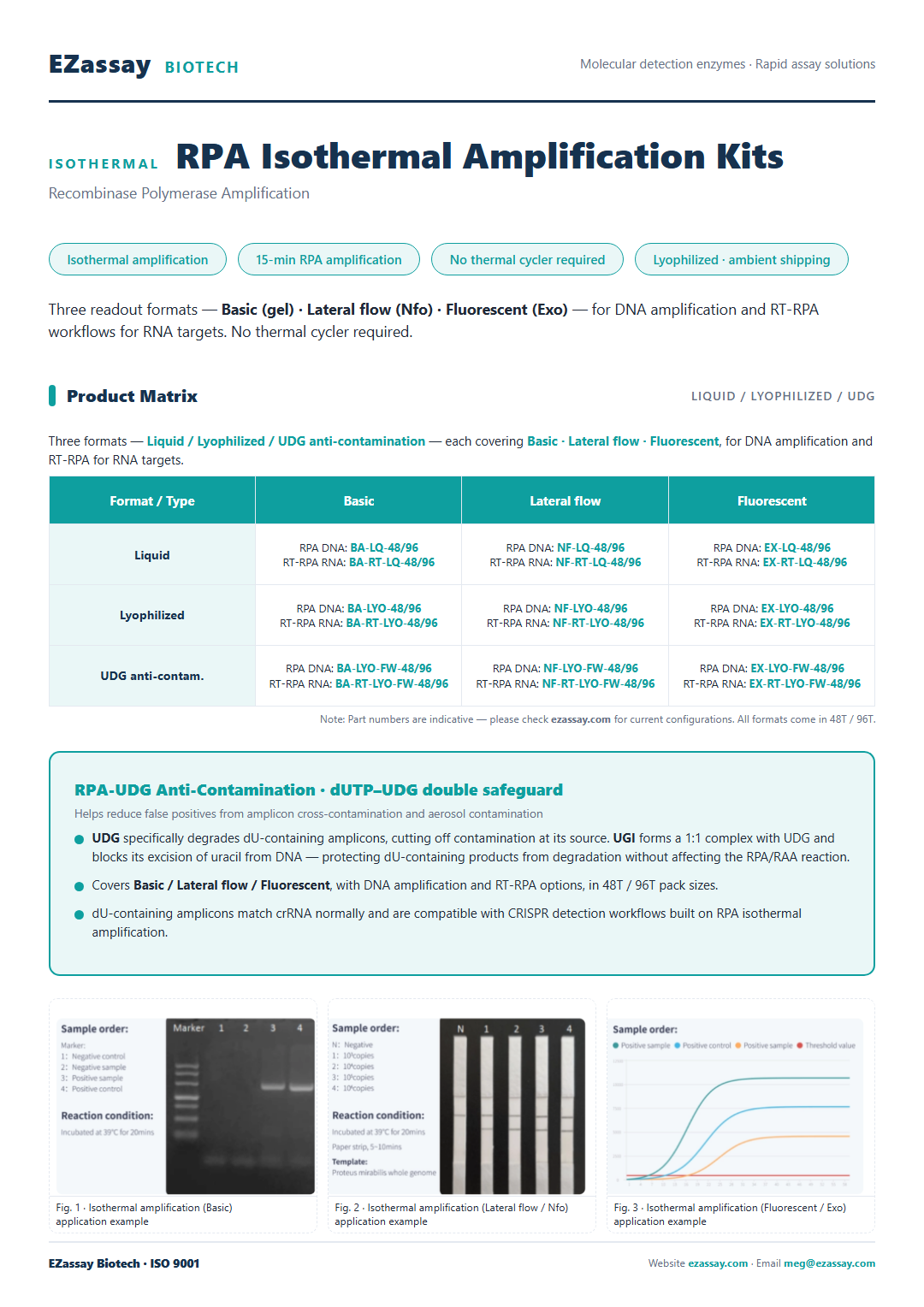
EZassay's contamination-control RPA kit incorporates a UDG-based strategy to help reduce the risk of aerosol carry-over contamination.
Published Use of EZassay RPA Kit
The study reports the use of EZassay's commercial RPA kit in a 20 µL reaction system according to the manufacturer's protocol. The Methods section states:
The RPA reaction was performed in a 20 µL reaction system using a commercial RPA kit (Shenzhen EZassay Biotechnology Co., Ltd., China) according to the manufacturer's protocol, with the integration of Uracil-DNA Glycosylase (UDG) system to prevent aerosol carry-over contamination. — Han X, et al. Rapid on-site detection of Pasteurella multocida in cattle using an LFS-based RPA-CRISPR/Cas12a assay. Irish Veterinary Journal. 2026. DOI: 10.1186/s13620-026-00360-4 · PMID 42806371
Three Practical Takeaways
- 1.Application Potential. RPA-CRISPR/Cas12a offers a promising approach for rapid pathogen detection in veterinary applications.
- 2.Contamination Control. UDG-based strategies are an important consideration in nucleic acid amplification workflows.
- 3.Practical Readout. Lateral flow strips enable visual interpretation without specialized fluorescence readers.
EZassay RPA Product Line
- ✔Efficient nucleic acid amplification
- ✔Compatibility with fluorescence-based detection
- ✔Lyophilized format for improved storage and shipping flexibility
- ✔Support for DNA amplification and RT-RPA workflows for RNA targets
- ✔Reagents for fluorescence-based and lateral flow detection workflows
- ✔Application support and assay customization
Q&A
Whether you're at the primer screening stage or developing a POCT product for scale-up, our team can help identify suitable isothermal amplification reagents and workflows for your application.
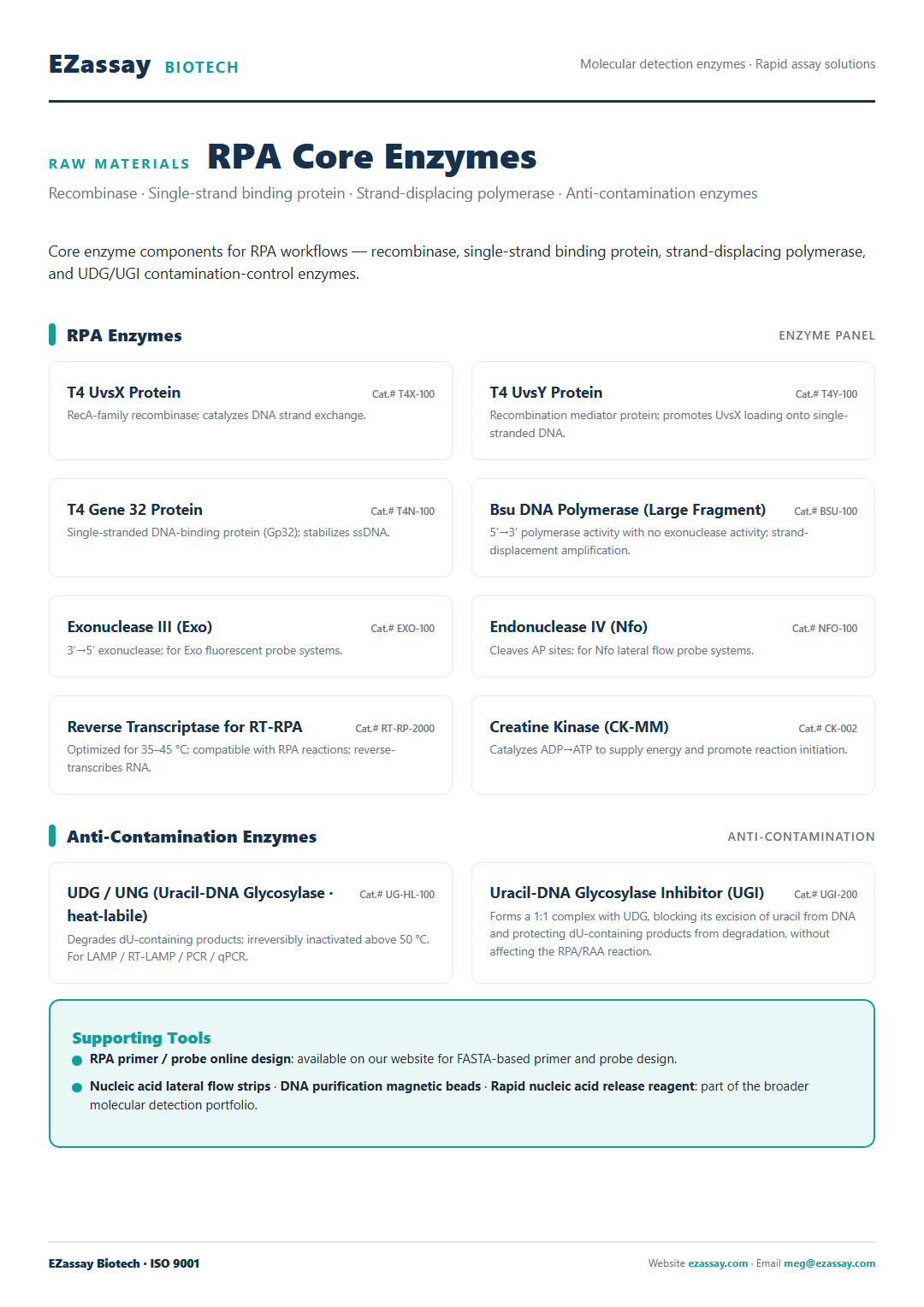
EZassay provides a range of isothermal amplification reagents for basic, fluorescence-based, and lateral flow detection workflows, alongside Cas proteins and other tools for molecular detection research.
Our UDG-based contamination-control RPA kit helps reduce the risk of carry-over contamination, while our lyophilized RPA format offers greater flexibility for ambient-temperature storage and shipping. Both address practical challenges in developing POCT products for settings where cold-chain logistics may be difficult.
For application advice, technical references, or product selection support, contact our team at meg@ezassay.com.
EZassay Biotech
Focused on isothermal amplification — RPA, LAMP, RCA, and nucleic acid modification tools.
Making detection simpler.
Simplifying Science. Empowering You.