Protein expression can be a bit like keeping a cat: unpredictable during growth, uncooperative when it's time for purification. And sometimes the affinity tag simply refuses to come off. The problem may not be your protein — it could be your TEV protease.
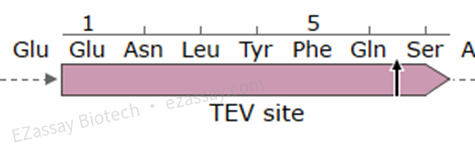
TEV protease (recombinant tobacco etch virus protease) is widely used to remove affinity tags from recombinant fusion proteins. It recognizes the degenerate seven-residue motif EXXYXQ↓(G/S) with high specificity, enabling targeted tag removal while limiting unwanted cleavage. Following cleavage, His-tagged components can be separated from the target protein by Ni-NTA affinity chromatography.
The two EZassay TEV proteases are complementary rather than interchangeable:
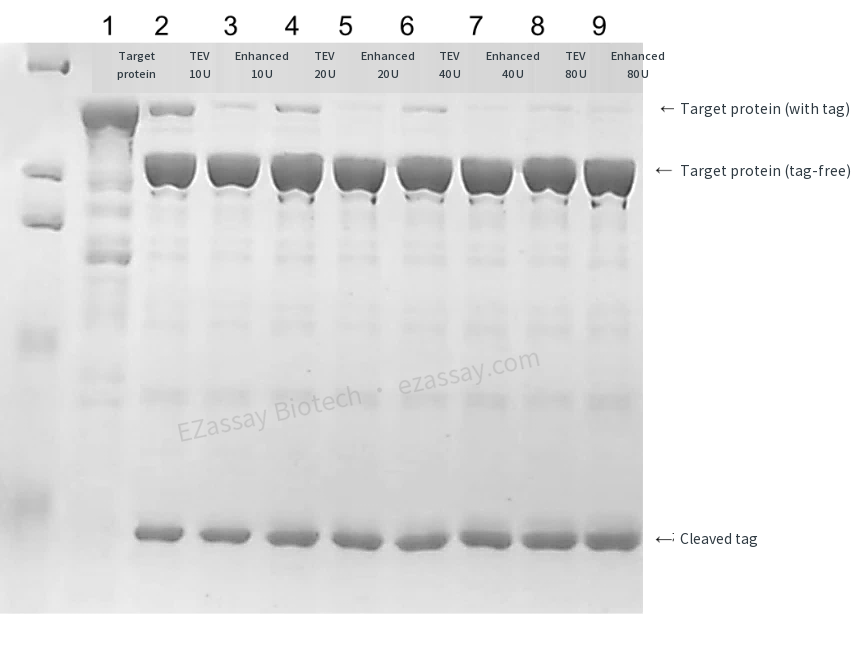
TEV Protease, Enhanced (5 U/μL; Cat. No. TEV-1000 / TEV-10000): delivers approximately 30% higher cleavage efficiency than conventional TEV protease under the same test conditions. A practical choice for routine tag removal, particularly in low-salt systems.
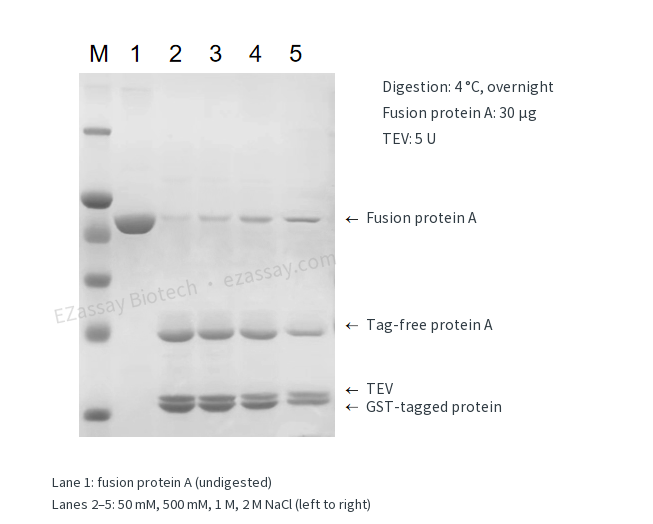
TEV Protease, High-Salt (5 U/μL; Cat. No. TEV-HS-1000 / TEV-HS-10000): built for high-salt conditions. Activity is well maintained up to 0.2 M NaCl, and partial activity is retained at 2 M NaCl. That matters when the eluate itself carries high salt, as with high-imidazole Ni-NTA fractions.
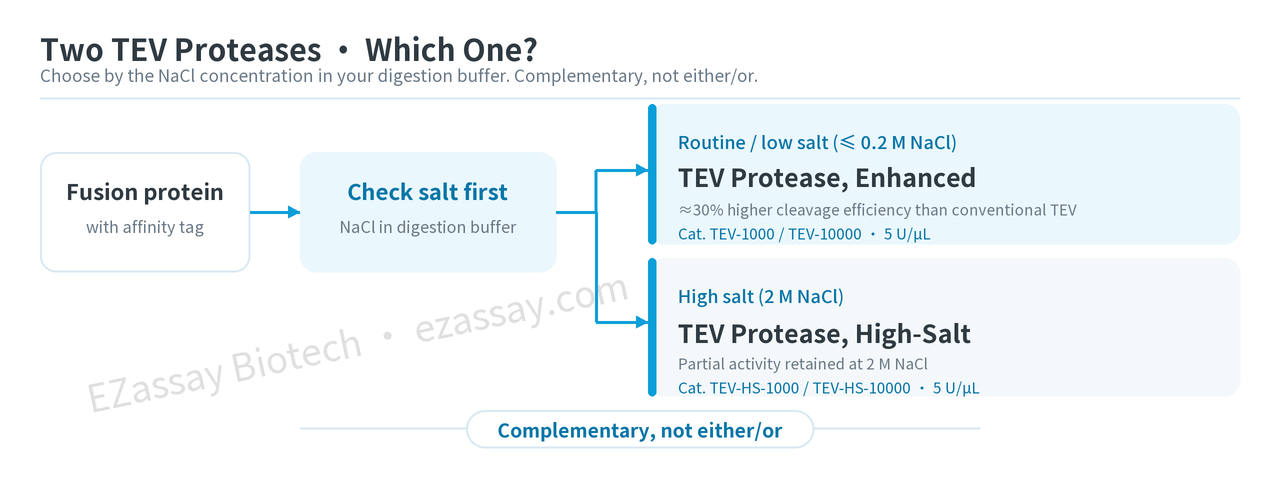
Choose the variant that matches the salt concentration of your system, and optimize the enzyme-to-substrate ratio for your substrate as described in the manual. For the manual, specifications, or a quotation, please get in touch.
The full TEV protease range, with specifications and pack sizes, is listed here: TEV Protease — EZassay enzymes.