There is a contaminant in the cell culture lab that is easy to miss. The medium looks clear, the cells look healthy, and the mycoplasma is already there. By the time it is found, a batch of cultures and weeks of work usually go with it.
Sensitivity is not where mycoplasma screening fails. Trust in the result is.
LAMP copies a target a million-fold. That is what makes it sensitive, and it is also why amplicon released as aerosol can be carried into the next reaction and turn a true negative into a false positive. The problem is rarely the chemistry — it is what happens between amplification and readout.
Traditional compendial culture testing can take weeks, which rarely fits a screening cadence that runs week after week.
The kit pairs isothermal LAMP amplification with lateral-flow strip readout, and puts aerosol control into the consumables themselves.
The gap is closed by design, not by care
Amplification and detection happen in one sealed assembly. After 30 minutes at 65 °C, a button on the detection tube is turned, driving the lateral-flow strip down into the reaction liquid. The tube is never opened after amplification — nothing is pipetted out, and the amplicon has no route into the room or into the next tube. Results are read by eye five minutes later: about 40 minutes from sample to answer, with no benchtop molecular instrument and no extraction step.
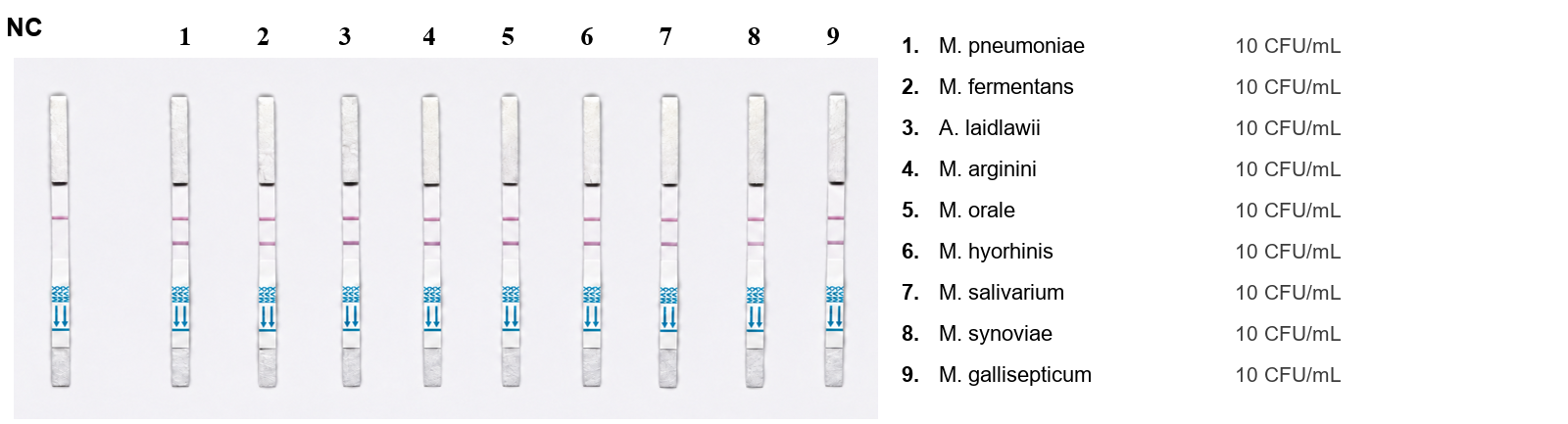
- Compendial strain coverage:Nine strains from the panel proposed in Ph. Eur. 2.6.7 (12.2) have each been verified at 10 CFU/mL. Strain selection in that chapter is risk-based, taking account of material source and process; the nine here were chosen for mammalian cell culture work. Suited to pre-release screening and cell bank establishment screening.
- Aerosol containment:Amplification and readout happen in the same tube and the cap is never opened afterwards, so the amplicon has no path out into the room or into the next reaction.
- Low readout barrier:After isothermal amplification the strip is read by eye; no benchtop molecular instrument is required.
- Defined target:The assay targets the mycoplasma 16S rRNA gene; the IFU lists 20 species, including the nine strains in the panel below.
- Clear fit:Routine cell culture screening, pharmaceutical QC and CRO labs running continuous testing.
Beyond those nine
Verified to detect more than 20 common mycoplasma contaminants of cell culture, including the nine strains from the panel proposed in Ph. Eur. 2.6.7 (12.2): M. hyorhinis, M. fermentans, M. arginini, M. hominis, M. orale, M. salivarium, M. pirum, A. laidlawii, M. pneumoniae, M. bovis, M. bovoculi, A. axanthum, M. buccale, M. agalactiae, M. arthritidis, M. pulmonis, M. gallisepticum, M. gallinarum, M. canis and Ureaplasma urealyticum.
Side by side with the compendial culture method
Eight cell culture supernatant samples (six positive, two negative) were run in parallel. Against the compendial culture method as reference, the strip assay gave positive agreement of 100% (6/6) and negative agreement of 100% (2/2); visual readout matched the strips.
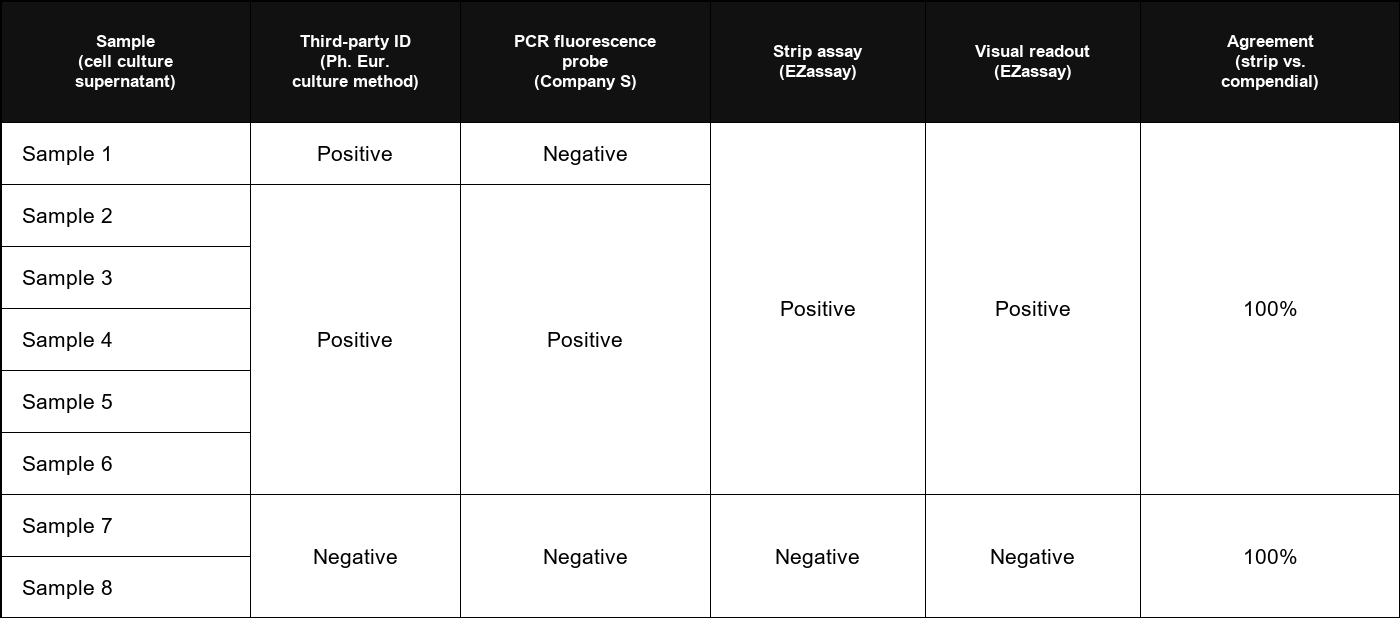
One entry is worth a look. Sample 1 read negative on a commercial PCR fluorescence-probe assay, while this kit and the compendial culture method both called it positive. Nucleic acid results are affected by sample matrix and by inhibitory substances carried through preparation, which is why Ph. Eur. 2.6.7 (12.2) now builds inhibition testing and method suitability into NAT validation.
Performance at a glance
| Parameter | Verified |
|---|---|
| Detection limit | 10 CFU/mL, per strain (nine strains) |
| Time to result | approx. 40 min (30 min amplification + 5 min readout) |
| Sample preparation | 200 µL supernatant, 99 °C for 5 min; no extraction |
| Open-tube step after amplification | none |
| Species coverage | more than 20 |
| Agreement, n = 8 | positive 6/6, negative 2/2 |
For labs screening week after week, the number that erodes confidence is not the limit of detection. It is a negative that does not repeat. Removing the open-tube step removes the most common reason it does not.
Where it fits
- Routine cell culture contamination screening
- Cell bank establishment screening
- Pre-release screening in pharmaceutical QC laboratories
- CRO and biotechnology laboratories running continuous testing
For research use.
Data first, or run your own samples
We can share the raw verification data for the nine strains and the full method comparison — or you can start with the 16-test pack (MYCO-FR-LYO-16) on samples from your own lab. Get in touch at meg@ezassay.com and we will suggest a verification plan and pack size for your sample type.
Mycoplasma LAMP Detection Kit, lateral-flow strip readout — MYCO-FR-LYO-16 (16 tests) · MYCO-FR-LYO-96 (96 tests)
For research use only (RUO). Not claimed as a validated replacement for compendial testing. Any use in regulated quality control should be supported by laboratory-specific method validation and suitability assessment.