2026-3-30
Technical Application Note: TtAgo Protein Performance & Optimization
Struggling with background noise or low sensitivity in your Argonaute assays?
【Mechanism of Action】
TtAgo Protein, also known as TtAgo Endonuclease, is a DNA-guided endonuclease derived from the Gram-negative thermophile Thermus thermophilus.
Guided by a 5′-phosphorylated single-stranded DNA (gDNA, 16–18 nt), TtAgo facilitates site-specific cleavage of target nucleic acid sequences complementary to the guide. The catalytic reaction is activated by divalent metal ions (e.g., Mg²⁺ or Mn²⁺) at the RNase H-like active site. The precise cleavage typically occurs between the 10th and 11th nucleotides of the guide DNA sequence.
【Thermal Profile】
- Active Range: 55–85°C
- Optimal Temperature: 65–85°C
- Technical Note: Catalytic activity significantly decreases when the reaction temperature drops below 65°C.
【Pro-Tips for Assay Development】
In R&D feedback, common challenges include: "Why is my TtAgo activity lower than expected?" or "How do I eliminate severe non-specific degradation?"
Key Insight: TtAgo performance depends not only on enzyme purity but also on the precision tuning of the reaction system. To maximize cleavage efficiency and specificity, the following experimental details are critical:
1. Pre-assembly of the Binary Complex
Pre-assembly with gDNA is essential to minimize non-specific activity. In the absence of a guide, TtAgo may trigger a "chopping" mechanism, causing non-specific degradation of dsDNA—a process believed to be TtAgo generating its own guides from exogenous DNA.
- Optimization: Ensure the molar ratio of gDNA to TtAgo is at least 5:1.
- Protocol: Pre-incubate TtAgo and gDNA at 75°C for 10–30 minutes to form a stable ribonucleoprotein (RNP)-like complex before adding the substrate.
2. Divalent Cation Balance
While Mg²⁺ is the standard cofactor, Mn²⁺ can also drive catalytic activity (recommended concentration: ~0.2 mM).
- Warning: Excess Mn²⁺ concentrations may inhibit enzyme activity and induce high-temperature non-specific degradation, particularly for RNA substrates.
3. Substrate Preference
TtAgo exhibits the highest activity toward ssDNA substrates, followed by dsDNA, with relatively lower activity for ssRNA.
- Note: TtAgo generates a specific nick on the DNA strand complementary to the gDNA rather than a double-strand break. TtAgo shows no activity against double-stranded RNA (dsRNA).
Activity Benchmarking: EZassay TtAgo vs. Industry Standards
The EZassay R&D team conducted comparative cleavage assays to validate the specific activity of our recombinant TtAgo.
Experimental Parameters:
- System: TtAgo / gDNA / ssDNA Reporter (FAM-BHQ1)
- Conditions: 75°C for 40 min
- Replication: n=2 technical replicates to ensure reproducibility.
Results & Conclusion:
- Rapid Signal Onset: EZassay TtAgo exhibits a significantly shorter lag phase, with fluorescence initiation observed at earlier time points.
- Early Saturation: Within the 40-min window, the EZassay group reached the signal plateau faster with superior total fluorescence increment.
- Superior Reproducibility: High alignment between technical replicates (n=2) demonstrates consistent batch-to-batch performance and system stability.
- Disclaimer: Data generated in EZassay R&D standard systems. Actual efficiency may vary based on substrate topology, ionic ratios, and pre-assembly protocols. Gradient optimization is recommended for specific diagnostic workflows.
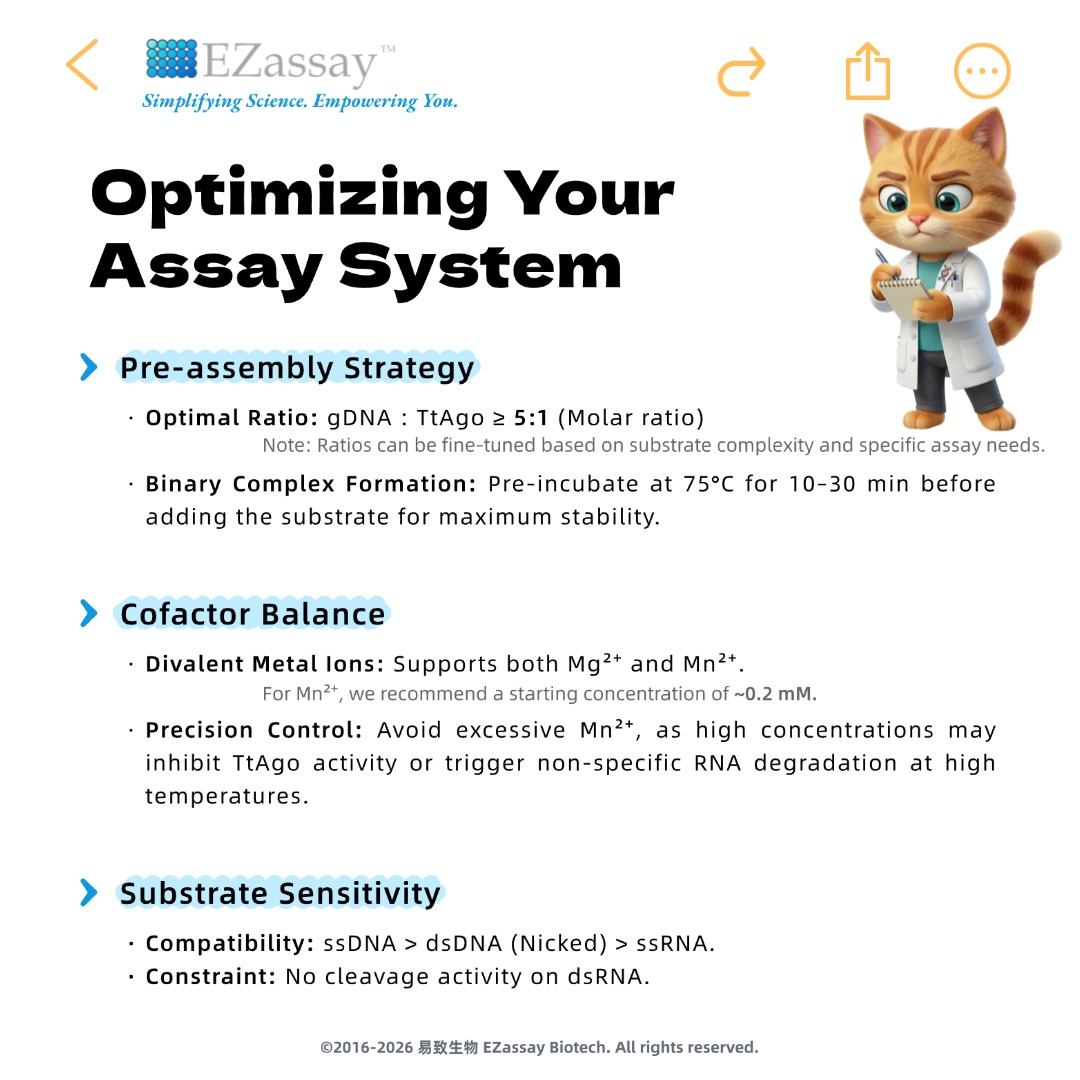 Optimization Guide: Mastering gDNA pre-assembly at 75°C and precision cofactor balance.
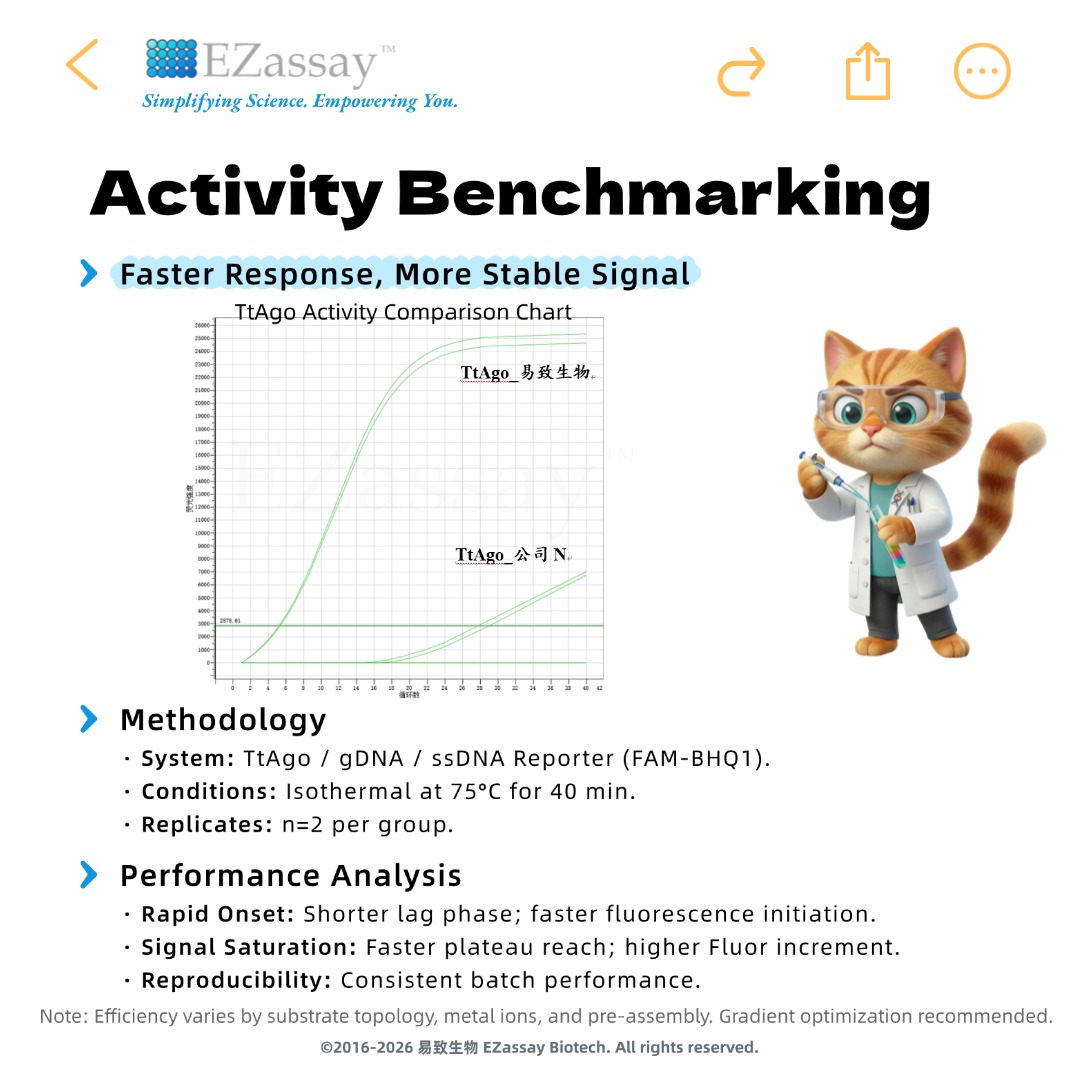 Performance Validation: Benchmarking EZassay TtAgo activity with faster fluorescence onset and earlier saturation.
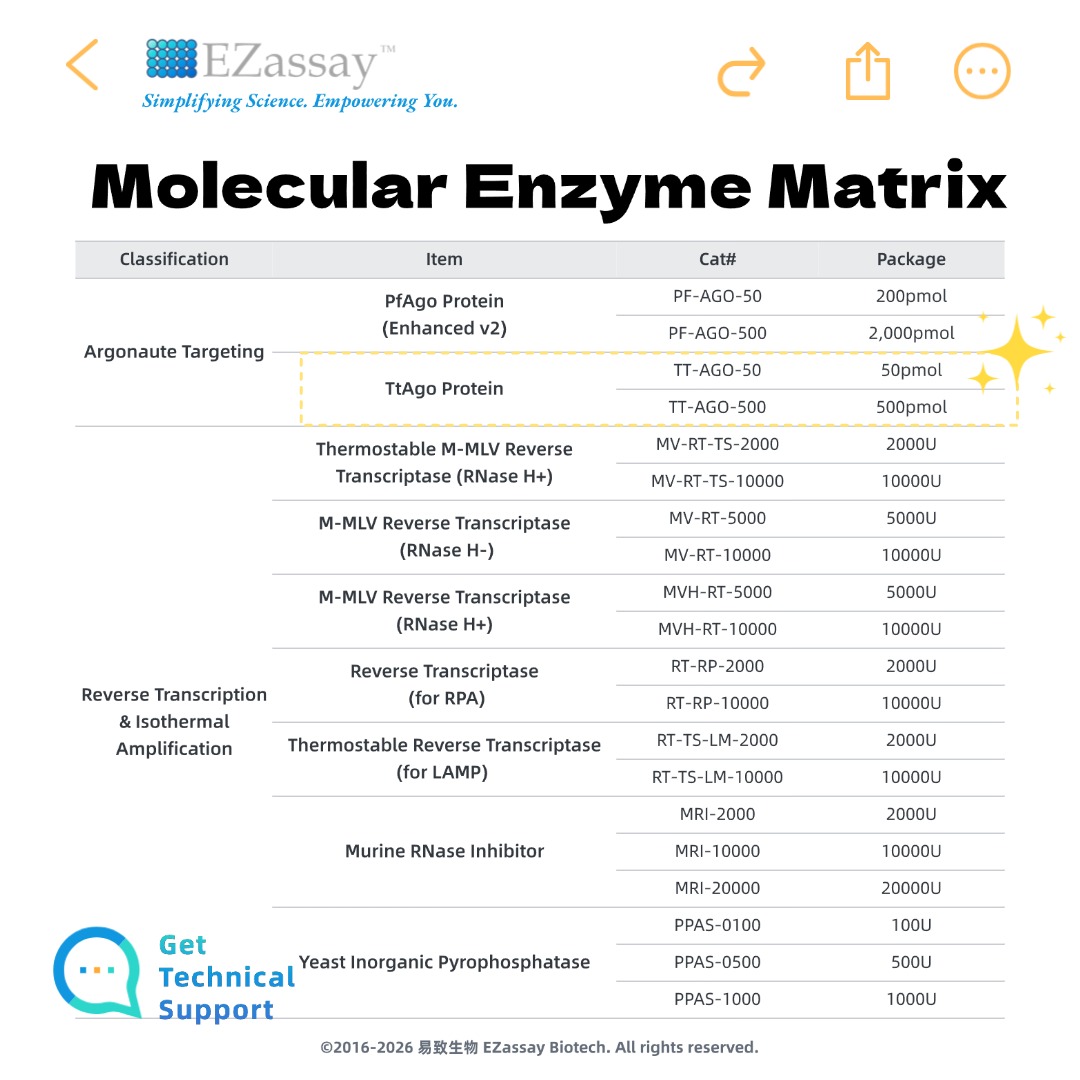 EZassay Molecular Enzyme Series: A comprehensive matrix for Argonaute, Reverse Transcription & Isothermal, Nucleic Acid Modification, and Protease Tools.
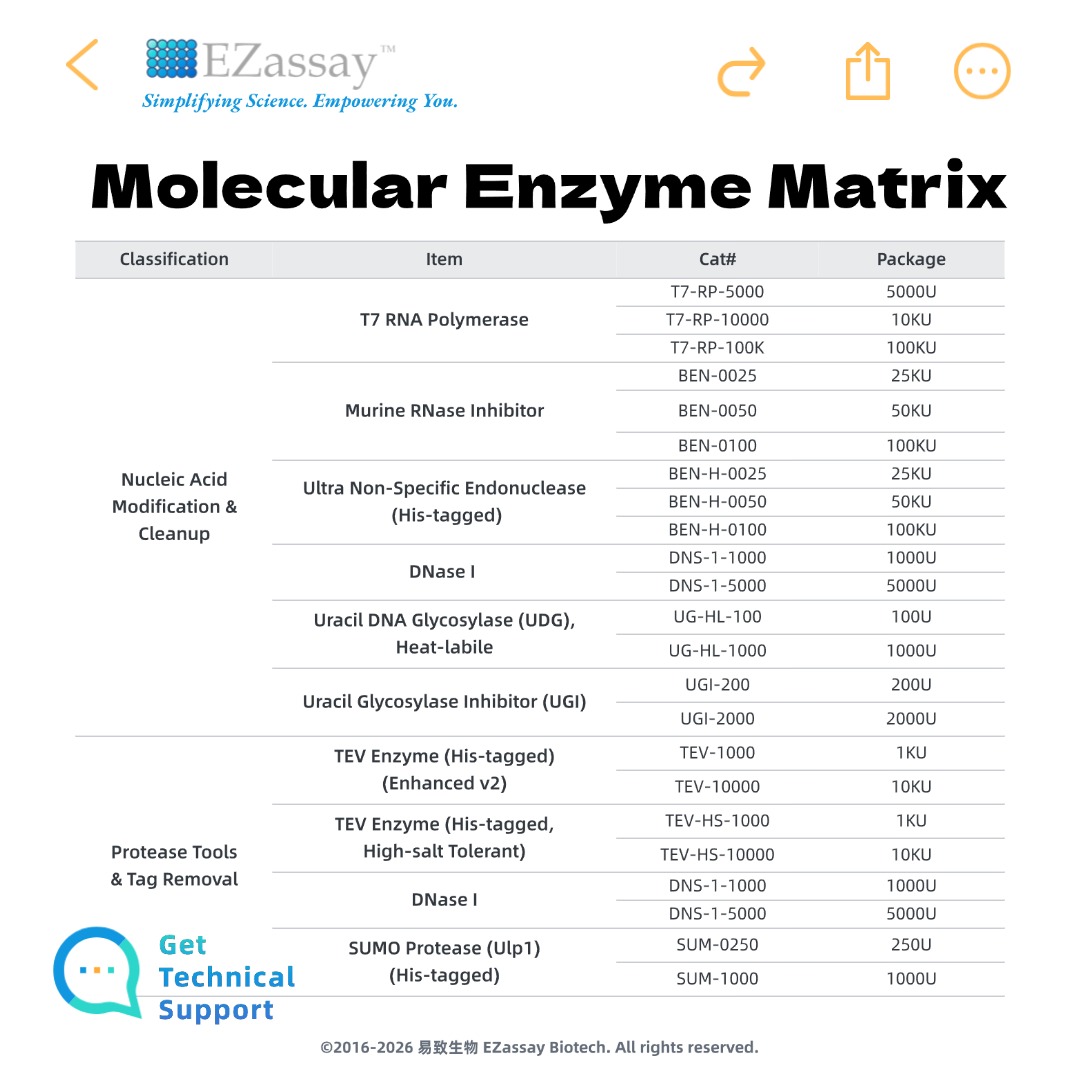 EZassay Molecular Enzyme Series: A comprehensive matrix for Argonaute, Reverse Transcription & Isothermal, Nucleic Acid Modification, and Protease Tools.
A Professional Molecular Enzyme Matrix The launch of TtAgo is part of our broader commitment to providing a comprehensive suite of high-performance functional enzymes. Led by our senior R&D team from the University of Hong Kong (HKU), we continue to expand our Molecular Enzyme Matrix to support every stage of your workflow:
- Argonaute Targeting Series: TtAgo & PfAgo (Enhanced v2).
- Isothermal Amplification: Thermostable M-MLV Reverse Transcriptase & Murine RNase Inhibitors.
- Nucleic Acid Cleanup: Ultra Non-Specific Endonuclease (Tag-free/His-tag) & T7 RNA Polymerase & DNase I & UDG & UGI.
- Protease Tools: High-specificity TEV & SUMO Proteases for seamless, native-end tag removal.
Your Strategic Partner in Enzyme Engineering
We aren't just a reagent supplier; we are your partner in molecular innovation. By focusing on stringent quality control and optimized production, we ensure that our enzymes perform reliably from the first pilot test to full-scale application.
Ready to evaluate TtAgo for your next project?
Keywords
TtAgo, Endonuclease, Thermus thermophilus Argonaute, pAgo Protein, Recombinant Enzyme, DNA-guided cleavage, CRISPR-alternative, Isothermal Amplification, Molecular Diagnostics, Gene Detection, PAM-independent